
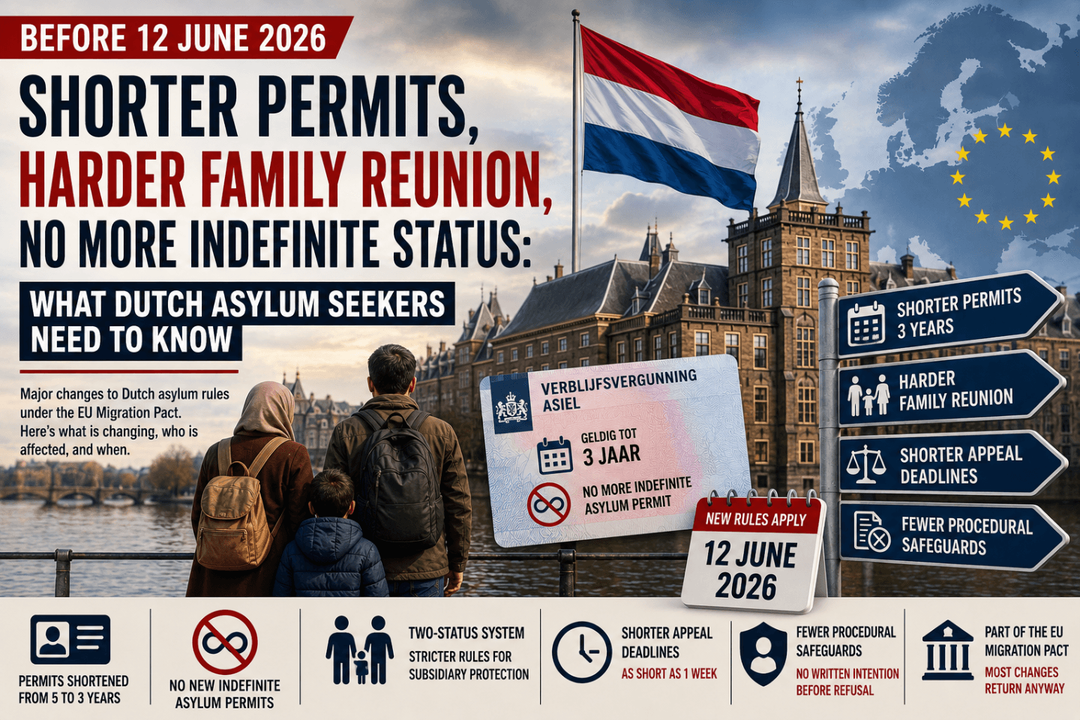
Shorter permits, harder family reunion, no more indefinite status: what Dutch asylum seekers need to know before 12 June 2026
The Netherlands is preparing major asylum-law changes tied to the EU Migration Pact, expected to take effect around 12 June 2026. Although one controversial asylum bill was rejected by the Dutch Senate, many key measures are returning through EU Pact implementation laws.
On 21 April 2026, the Dutch Senate (Eerste Kamer) voted down one of the two asylum bills of the Schoof cabinet, the Asielnoodmaatregelenwet (Asylum Emergency Measures Act). The companion bill, the Wet invoering tweestatusstelsel (Two-Status System Act), passed on the same day. Within hours, the Minister of Asylum and Migration Van den Brink told the press: "I will repair what has not been adopted" ("Ik ga herstellen wat niet is aangenomen").
Although the Asielnoodmaatregelenwet failed, many of the discretionary national choices the Faber bills wanted to introduce are now reframed as Pact-implementation. The same Senate that rejected the Asielnoodmaatregelenwet is institutionally constrained to adopt the implementation bill, because rejecting it would put the Netherlands in breach of binding EU obligations.
This post is for people who already have an asylum permit, people currently waiting on a decision, and people considering family reunification. It explains, in concrete terms, what is changing for you, and when.
Change 1 — Shorter asylum permits
The asylum residence permit (verblijfsvergunning asiel) is being shortened from five years to three years. The Qualification Regulation requires only a minimum of three years for refugees and one year (renewable for two) for subsidiary protection beneficiaries under Article 24. The Netherlands could have kept five years; it chose to drop to the EU minimum.
Change 2 — Abolition of the indefinite asylum permit
Until now, after five years, a status holder could obtain an indefinite asylum permit (verblijfsvergunning asiel voor onbepaalde tijd) under Article 33 of the Vreemdelingenwet 2000 (Aliens Act). The indefinite permit is harder to revoke than a fixed-term one. Removing this is a national choice; nothing in the Qualification Regulation requires it.
Who is affected by Changes 1 and 2?
Category 1 — You already hold a five-year asylum permit. Your existing five-year permit retains its full original validity until expiry. But on renewal, the new three-year duration applies — under the new Article 9(3) of the Vreemdelingenwet, renewals are also for three years. The legal basis for granting a new indefinite asylum permit (Article 33) disappears on the date the implementation bill enters into force. Plenary debate in the Senate is scheduled for 19 May 2026, with a vote expected the following week. The bill is intended to enter into force on or around 12 June 2026.
Category 2 — You applied for asylum before 12 June 2026 and are waiting for a decision. The procedural rules of the old regime continue to apply to your application — you keep the right to receive a written intention before the decision (the voornemenprocedure), the longer appeal periods, and the old decision deadlines. But the duration of the permit you receive, if granted, follows the new regime. Someone who applied in March 2026 but whose decision is taken in August 2026 will be granted a three-year permit, even though under the old Article 28 of the Vreemdelingenwet they would have received five years.
Category 3 — You apply for asylum on or after 12 June 2026. The full new regime applies. If granted, you receive a three-year permit.
Category 4 — You already hold an indefinite asylum permit (Article 33). You retain your status. The transitional provisions of the implementation bill (Article IX(2)) explicitly protect indefinite permits already granted. No new indefinite permits will be granted after the law's entry into force.
What this means for citizenship applications
The substantive criteria for Dutch naturalisation, set out in Article 8 of the Rijkswet op het Nederlanderschap (RWN) (Netherlands Nationality Act), remain textually identical. The five-year residence requirement, the non-temporary purpose-of-stay requirement (an asylum permit is treated as non-temporary for naturalisation purposes), the integration requirement (inburgering), and the renunciation rule with its exceptions (refugees are exempt from the renunciation requirement) all stay formally the same.
What is now different in practice:
The IND can revoke refugee or subsidiary protection status before you reach the five-year mark, applying Articles 14 and 19 of the Qualification Regulation through the procedure in Articles 65 and 66 of the Asylum Procedure Regulation. On a three-year permit cycle, this assessment effectively occurs every three years, at renewal, rather than every five years as before.
Important: the five-year residence requirement under Article 8(1)(c) RWN is calculated from the date your asylum residence permit was granted, not from the date of arrival or of the asylum application. If you naturalise before any reassessment finds that protection is no longer needed, you keep your route to citizenship. If a reassessment leads to revocation before the five-year mark, the route is broken.
For European long-term resident status (a separate path under Directive 2003/109/EC as amended by Article 40 of the Qualification Regulation), the time spent waiting for the asylum decision now counts in full toward the five-year residence requirement. This is one of the few changes that is, for status holders, slightly more favourable than the old rule.
Change 3 — The two-status system
The Wet invoering tweestatusstelsel was adopted by the Senate on 21 April 2026. Its date of entry into force is set by royal decree (koninklijk besluit); the working assumption is 12 June 2026, aligned with the Pact rollout.
The wet introduces differential treatment between two groups of family reunification applicants. The Qualification Regulation permits but does not mandate this differentiation.
Group A — Family of recognised refugees
If you have refugee status under Article 1A of the 1951 Refugee Convention (persecution because of political opinion, religion, ethnicity, nationality, or membership of a particular social group), the favourable family reunification regime applies:
- Eligible family members: spouse, biological or adopted minor child, and (for unaccompanied minors) parents and minor siblings
- Application within three months of your asylum permit being granted
- No income requirement
- No housing requirement
- No waiting period
- Granted under Article 13 of the Family Reunification Directive 2003/86/EC
Important changes for Group A under the new regime:
-
Unmarried partners are excluded. The old Article 29(2)(b) of the Vreemdelingenwet explicitly covered partners and dependent adult children with a dependency requirement. The new Article 29c restricts the family list to spouses, minor children, and (for unaccompanied minor refugees) parents and minor siblings. If you have an unmarried partner — including a same-sex partner you cannot legally marry in your country of origin — they no longer have a nareis (family reunification) route. The remaining option is the regular family reunification track under Article 14 Vreemdelingenwet, which is significantly stricter.
-
Adult children are excluded. Children who were already adults at the moment you fled, and who remained factually part of the family unit, used to qualify under a strict but real route based on demonstrated dependency. The new Article 29c(1)(b) restricts the child category to minor biological or adopted children. Adult dependent children no longer have an asylum-track nareis route.
-
Siblings of unaccompanied minors are now explicitly included. This is one of the few additions. Minor siblings of an unaccompanied minor refugee can now apply alongside a parent under the new Article 29c(1)(d).
-
Permit duration is reduced to three years. Under the new Article 9(4) of the Vreemdelingenwet, the family member's permit expires on the same date as yours. Since you now hold a three-year permit, your family also holds an effective three-year permit, with renewal cycles tied to yours.
-
Several procedural changes apply. The right to receive a written intention before a decision (the voornemenprocedure) is abolished. Appeal periods are shortened. The reception agency COA can withdraw or limit reception facilities (housing, allowance) for non-compliance with mandatory Dutch-language and civic-knowledge courses (new Article 11 Vreemdelingenwet).
How this affects you (Group A)
Category 1 — You are already a refugee, and your family is already here. No retroactive effect. The new regime does not impose new conditions on already-granted family permits.
Category 2 — You have a pending family reunification application lodged before entry into force. Standard Dutch transitional law (the principle of eerbiedigende werking — respecting existing legal positions — for procedural matters) means that pending applications are processed under the procedural rules of the old regime. You retain the voornemenprocedure, the old appeal periods, and the old decision deadlines. The implementation bill confirms this explicitly in Article IX(1).
However, the same Article specifies the protection only as far as concerns "the voornemen and views procedure" — meaning only procedural protection, not substantive. So your family member, if their application is granted on or after 12 June 2026, will receive a three-year permit, and the renewal regime will apply to them under the new rules.
Category 3 — You apply for family reunification on or after 12 June 2026. The full new regime applies, both procedurally and substantively.
Group B — Family of subsidiary protection beneficiaries
If you have subsidiary protection status (granted because of indiscriminate violence in armed conflict, or because of a real risk of serious harm short of refugee persecution, typically the status given to people fleeing war zones rather than targeted persecution), the new regime is significantly stricter:
- Same family-member definition as Group A: spouse, minor children. Partners are excluded; adult dependent children are excluded.
- A two-year waiting period since the grant of subsidiary protection to you
- Income requirement: independent and durable sufficient means of subsistence
- Housing requirement: appropriate housing must be available
- The income and housing conditions do not apply if you are an unaccompanied minor
Important changes for Group B under the new regime:
-
Two-year waiting period. You must have held subsidiary protection for at least two years before applying for family reunification. For families fleeing the same conflict, Syria, Sudan, Yemen, and Ukraine, separation is now legally enforced for two additional years compared to families of refugees from the same conflict zone.
-
Income requirement. You must have zelfstandig en duurzaam (independent and durable) sufficient means of subsistence. Under standard Dutch interpretation, this means stable income at or above the minimum-wage level, typically demonstrated over at least 12 months.
-
Housing requirement. Adequate housing must be available. The bill explicitly states that doorstroomlocaties (transit accommodation) count as adequate housing, apparently intended to mitigate the impact of the Dutch housing crisis on status holders, but still an additional procedural hurdle.
-
Permit duration. Same as Group A: three-year derivative permit under Article 9(4), renewable on the same cycle as yours.
-
Procedural restrictions. Same as Group A: no voornemenprocedure, shortened appeals, possible reception sanctions.
-
Continuing dependency on the principal. If your subsidiary protection is later revoked, or if your income or housing situation changes such that the original conditions are no longer met, your family member's permit can also be revoked under the new Article 32(5) of the Vreemdelingenwet. This dependency between the family member's permit and your status did not exist under the old regime.
How this affects you (Group B)
Category 1 — You already have subsidiary protection and your family is already here. No retroactive effect.
Category 2 — You have a pending family reunification application lodged before entry into force. Standard Dutch transitional-law practice indicates that pending applications are decided under the law as it stood at the time of application. The strict two-year waiting period, income requirement, and housing requirement should not apply to applications already lodged before 12 June 2026. But your family member, if granted a permit on or after 12 June 2026, will receive a three-year permit and will be subject to the new dependency-based revocation grounds going forward.
Category 3 — You apply for family reunification on or after 12 June 2026. Full new regime: two-year waiting period, income requirement, housing requirement.
A practical illustration: a Syrian man arrives in March 2026 and is granted subsidiary protection in October 2026. His wife and two minor children are in Turkey. Under the old regime, he could apply for family reunification immediately, with a realistic family reunion within 12-18 months. Under the new regime, he cannot apply until October 2028 (the two-year waiting period), must demonstrate stable independent income (likely meaning at least 12 months of stable employment at minimum-wage level), and must demonstrate adequate housing in a saturated housing market. Realistic family reunion: late 2029 or 2030. The family is separated for three to four years longer than under the old regime.
Change 4 — Faster procedures, shorter appeal periods
Under the old regime, asylum applications entered the AA-procedure (general asylum procedure), with eight working days for the IND to decide. If granted, you will receive a five-year permit. If rejected, you had a four-week appeal period and the right to receive a written intention before the decision (the voornemenprocedure) with a chance to respond.
Under the new regime, applications are processed under the time limits of Article 35 of the Asylum Procedure Regulation. If granted, you receive a three-year permit. If rejected, depending on the basis, the appeal period is significantly shortened.
| Decision type | Old appeal period | New appeal period |
| Not in consideration (Dublin transfer) | 4 weeks | 1 week |
| Inadmissible (e.g. safe third country) | 4 weeks | 1 week |
| Manifestly unfounded (kennelijk ongegrond) | 4 weeks | 1 week |
| Set aside (buiten behandeling gesteld) | 4 weeks | 1 week |
| Rejected as unfounded | 4 weeks | 2 weeks |
| Granted subsidiary protection (appeal seeking refugee status) | 4 weeks | 2 weeks |
| Status revocation (intrekking) | 4 weeks | 2 weeks |
| Higher appeal on the above | 4 weeks | 2 or 4 weeks |
In practical terms: a one-week appeal period means that if you receive a negative decision, you have seven days to find a lawyer who can take your case, get them access to the file, identify legal grounds for appeal, and file the appeal with the court. For someone in a foreign legal system, often without language skills, sometimes in detention, this is in practice often impossible.
Change 5 — Disappearing procedural safeguards
Beyond the shorter appeals, the implementation bill removes or weakens several other procedural safeguards. The most significant:
The voornemenprocedure is abolished. Under the new Article 39 of the Vreemdelingenwet (which excludes Articles 4:7 and 4:8 of the General Administrative Law Act from asylum applications), you no longer receive a written intention from the IND before a negative decision. The first formal opportunity to contest the IND's reasoning is now the appeal itself.
Statutory authorisation for restricting free legal counseling. The new Article 36(2)(c) of the Vreemdelingenwet expressly authorises the Minister, by ministerial regulation, to make rules "excluding or limiting" access to free legal counseling and legal representation. The bill does not itself exclude legal counseling — but it creates the legal hook for the Minister to do so by future regulation, with reduced parliamentary scrutiny.
Some appeals are removed entirely. Under the new Article 80, certain categories of unfavourable decisions cannot be appealed at all — including closure decisions and certain buiten behandeling decisions where the application was explicitly withdrawn.
What has not yet passed
Three measures from the rejected Asielnoodmaatregelenwet are not in the implementation bill. The Minister has announced separate legislative routes for each.
Abolition of the dwangsom (penalty payment for late decisions)
The dwangsom is the financial penalty the IND has to pay when it fails to decide on an asylum application within the statutory deadline. There are two types: the administrative-law dwangsom (which accrues automatically once you send a notice of default), and the judicial dwangsom (which a court can impose when ordering the IND to decide by a court-set deadline). Both exist to enforce your right to a timely decision.
The Asielnoodmaatregelenwet would have abolished the dwangsom. After that bill was rejected, abolition is now being pursued via an amendment by SGP and JA21 attached to a different pending bill — the Wet terugkeer en vreemdelingenbewaring (35.501) (Return and Alien Detention Act). That bill is scheduled for plenary debate in the Tweede Kamer after the May recess. So the dwangsom abolition has not yet been adopted; it is at the amendment-on-pending-bill stage and is unlikely to be operative until late 2026 or early 2027.
Broadening of ongewenstverklaring (declaration of undesirability)
A declaration of undesirability functions as an entry ban under Article 11 of the Return Directive, meaning the person is barred from returning to the Netherlands for a set period. The Minister wants to broaden the grounds on which an ongewenstverklaring can be issued. This is being pursued through a Nota van Wijziging (formal amendment by the government) attached to the same Wet terugkeer en vreemdelingenbewaring. Not yet submitted.
Criminalisation of unlawful stay (strafbaarstelling illegaal verblijf)
The Minister has announced a fresh bill specifically targeting rejected asylum seekers who do not cooperate with their return. Under the proposal, you could face criminal sanctions if your asylum claim has been finally rejected, you remain on Dutch territory, and you are not actively cooperating with return procedures. The targeted population is therefore people whose asylum procedures have ended without a positive outcome, who are not voluntarily leaving, and whom the authorities have not (yet) been able to remove involuntarily.
When the bill will be submitted is uncertain, at minimum several months. Realistic operational date: late 2027 or 2028 at the earliest.
The package of subordinate instruments
The implementation bill authorises a series of subordinate instruments — algemene maatregelen van bestuur (general administrative orders) and ministerial regulations — that will determine the operational reality of the new regime. These include:
- The ministerial regulation on safe-country-of-origin designations (new Article 32a Vreemdelingenwet)
- The ministerial regulation on legal counseling restrictions (new Article 36)
- Various administrative orders on procedural and substantive matters (new Articles 11, 27a(3), 29(2), 29a(2), 29b(2), 29c(3), 29d(4), 30b(3), 32(7), 41(6))
- Updated IND policy in the Vreemdelingencirculaire (Aliens Circular) and the IND Werkinstructies (operational work instructions)
These instruments receive far less parliamentary scrutiny than primary legislation. Some will be ready by 12 June 2026 because the system cannot operate without them: the safe-country list, the screening monitoring mechanism, and the basic operational structure for the new procedure. Others can be issued in stages over the following months and years, at the Minister's discretion.
The bigger picture: the Pact is doing the heavy lifting
As Hemme Battjes explains on Verblijfblog, the implementation bill adopted by the Tweede Kamer on 2 April 2026, already incorporates the bigger part of both Faber bills, including the shortening of asylum residence permits from five to three years and the abolition of the indefinite asylum permit, both originally in the rejected Asielnoodmaatregelenwet.
The Qualification Regulation is directly applicable, meaning it applies as Dutch law from its date of application without needing transposition. Most Pact instruments apply from 12 June 2026; the Qualification Regulation itself applies slightly later, from 1 July 2026. Member States may not maintain more favourable national rules, a freedom that Article 3 of the old Qualification Directive had explicitly allowed.
As VluchtelingenWerk Nederland notes, most of what the Senate refused will still return through different legislative routes. And most of what was already controversial in the Asielnoodmaatregelenwet has already been folded into the Uitvoerings- en implementatiewet Asiel- en migratiepact 2026 (the bill implementing the EU Migration Pact), currently before the Senate.

Silence is the worst enemy of freedom.